Great Pyramid of Giza

Hanging Gardens of Babylon

The Hanging Gardens of Babylon (also known as Hanging Gardens of Semiramis) (near present-day Al Hillah in Iraq) are considered one of the original Seven Wonders of the World. They were built by Nebuchadnezzar II around 600 BCE. He is reported to have constructed the gardens to please his wife, Amytis of Media, who longed for the trees and fragrant plants of her homeland.[1] The gardens were destroyed in an earthquake after the 1st century BCE.
Statue of Zeus at Olympia
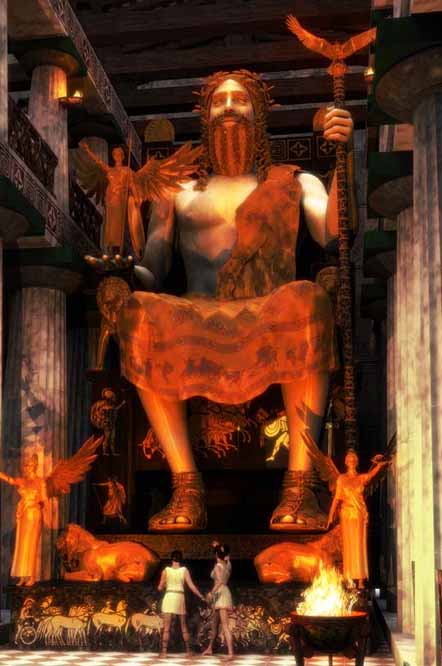
The Statue of Zeus at Olympia was one of the classical Seven Wonders of the Ancient World. It was made by the famed classical sculptor Phidias (5th century BC) circa 432 BC in Olympia, Greece.[1]The seated statue, some 40 feet (12 meters) tall, occupied the whole width of the aisle of the temple built to house it. "It seems that if Zeus were to stand up," the geographer Strabo noted early in the 1st century BC, "he would unroof the temple."[2] Zeus was a chryselephantine sculpture, made of ivory and accented with gold plating. In the sculpture, he was seated on a magnificent throne of cedarwood, inlaid with ivory, gold, ebony, and precious stones. In Zeus' right hand there was a small statue of Nike, the goddess of victory, and in his left hand, a shining sceptre on which an eagle perched.[3] Plutarch, in his Life of the Roman general Aemilius Paulus, records that the victor over Macedon “was moved to his soul, as if he had beheld the god in person,” while the Greek orator Dio Chrysostom wrote that a single glimpse of the statue would make a man forget his earthly troubles.The circumstances of its eventual destruction are a source of debate: some scholars argue that it perished with the temple in the 5th century AD, others argue that it was carried off to Constantinople, where it was destroyed in the great fire of the Lauseion (Schobel 1965). According to Lucian of Samosata in the later second century, "they have laid hands on your person at Olympia, my lord High-Thunderer, and you had not the energy to wake the dogs or call in the neighbours; surely they might have come to the rescue and caught the fellows before they had finished packing up the swag."[4]Perhaps the greatest discovery in terms of finding out about this wonder came in 1954-1958 with the excavation of the workshop at Olympia where Phidias created the statue. Tools, terracotta molds and a cup inscribed "I belong to Pheidias" were found here, where the traveller Pausanius said the Zeus was constructed.[5][6][7] This has enabled archaeologists to re-create the techniques used to make the great work.
Temple of Artemis

Mausoleum of Maussollos

Colossus of Rhodes

Lighthouse of Alexandria
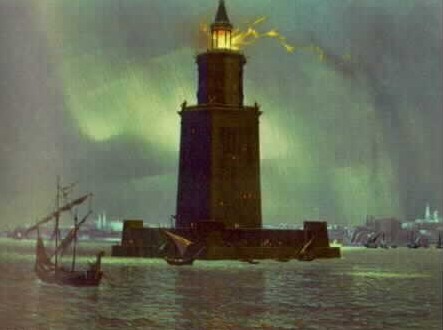
The lighthouse of Alexandria (or The Pharos of Alexandria, Greek: ὁ Φάρος τῆς Ἀλεξανδρείας) was a tower built in the 3rd century BC (between 285 and 247 BC) on the island of Pharos in Alexandria, Egypt to serve as that port's landmark, and later, its lighthouse.With a height variously estimated at between 115 ~ 150 meters (377 ~ 492 ft) it was among the tallest man-made structures on Earth for many centuries, and was identified as one of the Seven Wonders of the World by Antipater of Sidon. It was the third tallest building after the two Great Pyramids (of Khufu and Khafra) for its entire life. Some scholars estimate a much taller height exceeding 180 meters that would make the tower the tallest building up to the 14th century.


No comments:
Post a Comment