Saturday, December 22, 2007

NEW SEVEN WONDERS OF THE WORLD

The Pyramid at Chichén Itzá


The Pyramid at Chichén Itzá (before 800 A.D.) Yucatan Peninsula, Mexico

Chichén Itzá, the most famous Mayan temple city, served as the political and economic center of the Mayan civilization. Its various structures - the pyramid of Kukulkan, the Temple of Chac Mool, the Hall of the Thousand Pillars, and the Playing Field of the Prisoners – can still be seen today and are demonstrative of an extraordinary commitment to architectural space and composition. The pyramid itself was the last, and arguably the greatest, of all Mayan temples


Christ Redeemer


Christ Redeemer (1931) Rio de Janeiro, Brazil

This statue of Jesus stands some 38 meters tall, atop the Corcovado mountain overlooking Rio de Janeiro. Designed by Brazilian Heitor da Silva Costa and created by French sculptor Paul Landowski, it is one of the world’s best-known monuments. The statue took five years to construct and was inaugurated on October 12, 1931. It has become a symbol of the city and of the warmth of the Brazilian people, who receive visitors with open arms.


The Roman Colosseum


The Roman Colosseum (70 - 82 A.D.) Rome, Italy

This great amphitheater in the centre of Rome was built to give favors to successful legionnaires and to celebrate the glory of the Roman Empire. Its design concept still stands to this very day, and virtually every modern sports stadium some 2,000 years later still bears the irresistible imprint of the Colosseum's original design. Today, through films and history books, we are even more aware of the cruel fights and games that took place in this arena, all for the joy of the spectators.


The Taj Mahal


The Taj Mahal (1630 A.D.) Agra, India

This immense mausoleum was built on the orders of Shah Jahan, the fifth Muslim Mogul emperor, to honor the memory of his beloved late wife. Built out of white marble and standing in formally laid-out walled gardens, the Taj Mahal is regarded as the most perfect jewel of Muslim art in India. The emperor was consequently jailed and, it is said, could then only see the Taj Mahal out of his small cell window.


The Great Wall of China


The Great Wall of China (220 B.C and 1368 - 1644 A.D.) China

The Great Wall of China was built to link existing fortifications into a united defense system and better keep invading Mongol tribes out of China. It is the largest man-made monument ever to have been built and it is disputed that it is the only one visible from space. Many thousands of people must have given their lives to build this colossal construction.


Petra


Petra (9 B.C. - 40 A.D.), Jordan

On the edge of the Arabian Desert, Petra was the glittering capital of the Nabataean empire of King Aretas IV (9 B.C. to 40 A.D.). Masters of water technology, the Nabataeans provided their city with great tunnel constructions and water chambers. A theater, modelled on Greek-Roman prototypes, had space for an audience of 4,000. Today, the Palace Tombs of Petra, with the 42-meter-high Hellenistic temple facade on the El-Deir Monastery, are impressive examples of Middle Eastern culture.


Machu Picchu


Machu Picchu (1460-1470), Peru

In the 15th century, the Incan Emperor Pachacútec built a city in the clouds on the mountain known as Machu Picchu ("old mountain"). This extraordinary settlement lies halfway up the Andes Plateau, deep in the Amazon jungle and above the Urubamba River. It was probably abandoned by the Incas because of a smallpox outbreak and, after the Spanish defeated the Incan Empire, the city remained 'lost' for over three centuries. It was rediscovered by Hiram Bingham in 1911.

Thursday, December 20, 2007

MIDDLE AGES SEVEN WONDERS

Stonehenge


Stonehenge is a prehistoric monument located in the English county of Wiltshire, about 8 miles (13 km) north of Salisbury. One of the most famous prehistoric sites in the world, Stonehenge is composed of earthworks surrounding a circular setting of large standing stones. Archaeologists believe that the standing stones were erected around 2200 BC and the surrounding circular earth bank and ditch, which constitute the earliest phase of the monument, have been dated to about 3100 BC. The site and its surroundings were added to the UNESCO's list of World Heritage Sites in 1986 in a co-listing with Avebury henge monument, and it is also a legally protected Scheduled Ancient Monument. Stonehenge itself is owned by the Crown and managed by English Heritage while the surrounding land is owned by the National Trust.


Colosseum


The Colosseum or Coliseum, originally the Flavian Amphitheatre (Latin: Amphitheatrum Flavium, Italian Anfiteatro Flavio or Colosseo), is an elliptical amphitheatre in the centre of the city of Rome, Italy, the largest ever built in the Roman Empire. It is one of the greatest works of Roman architecture and engineering.Occupying a site just east of the Roman Forum, its construction started between 70 and 72 AD under the emperor Vespasian and was completed in 80 AD under Titus, with further modifications being made during Domitian's reign (81–96).[1] The name "Amphitheatrum Flavium" derives from both Vespasian's and Titus' family name ("Flavius, from the gens Flavia).Originally capable of seating around 50,000 spectators, the Colosseum was used for gladiatorial contests and public spectacles. It remained in use for nearly 500 years with the last recorded games being held there as late as the 6th century. As well ashe traditional gladiatorial games, many other public spectacles were held there, such as mock sea battles, animal hunts, executions, re-enactments of famous battles, and dramas based on Classical mythology. The building eventually ceased to be used for entertainment in the early medieval era. It was later reused for such varied purposes as housing, workshops, quarters for a religious order, a fortress, a quarry and a Christian shrine.Although it is now in a ruined condition due to damage caused by earthquakes and stone-robbers, the Colosseum has long been seen as an iconic symbol of Imperial Rome. Today it is one of modern Rome's most popular tourist attractions and still has close connections with the Roman Catholic Church, as each Good Friday the Pope leads a torchlit "Way of the Cross" procession to the amphitheatre.The Colosseum is also depicted on the Italian version of the five-cent coin.


Catacombs of Kom el Shoqafa


The Catacombs of Kom el Shaqafa, (meaning 'Mound of shards' or 'Potsherds'), is a historical archaeological site located in Alexandria, Egypt. The necropolis consists of a series of Alexandrian tombs, statues and archaeological objects of the Pharaonic funeral cult with Hellenistic and early Imperial Roman influences. Due to the time period, many of the features of the Catacombs of Kom el Shoqafa merge both Roman, Greek and Egyptian cultural points; some statues are Egyptian in style, yet bear Roman clothes and hair style whilst other features share a similar style. A circular staircase, which was often used to transport deceased bodies down the middle of it, leads down into the tombs that were tunneled into the bedrock during the age of the Antonine emperors (2nd century AD). The facility was then used as a burial chamber from the 2nd century to the 4th century, before being rediscovered in 1900 when a donkey accidentally fell into the access shaft. To date, three sarcophagi have been found, along with other human and animal remains which were added later. It is believed that the catacombs were only intended for a single family, but it is unclear why the site was expanded in order to house numerous other individuals. The Catacombs of Kom el Shoqafa is, according to some lists, also one of the Seven Wonders of the World in the Middle Ages.One of the more gruesome features of the catacombs is the Hall of Caracalla, a mass burial chamber for the humans and animals massacred by order of the Emperor Caracalla after he violated them. He was often in various orgies in 215 AD. It was placed as an addition into the original chamber on Caracalla's orders.


Great Wall of China


The Great Wall of China (simplified Chinese: 长城; traditional Chinese: 長城; pinyin: Chángchéng; literally "Long wall") or (simplified Chinese: 万里长城; traditional Chinese: 萬里長城; pinyin: Wànlǐ Chángchéng; literally "The long wall of 10,000 Li (里)"[1]) is a series of stone and earthen fortifications in China, built, rebuilt, and maintained between the 5th century BC and the 16th century to protect the northern borders of the Chinese Empire during the rule of successive dynasties. Several walls, referred to as the Great Wall of China, were built since the 5th century BC. The most famous is the wall built between 220 BC and 200 BC by the first Emperor of China, Qin Shi Huang; little of it remains; it was much farther north than the current wall, which was built during the Ming Dynasty.[2]The Great Wall is the world's longest human-made structure, stretching over approximately 6,400 km (4,000 miles)[3] from Shanhaiguan in the east to Lop Nur in the west, along an arc that roughly delineates the southern edge of Inner Mongolia, but stretches to over 6,700 km (4,160 miles) in total.[4] It is also the largest human-made structure ever built in terms of surface area and mass.[citation needed] At its peak, the Ming Wall was guarded by more than one million men.[5] It has been estimated that somewhere in the range of 2 to 3 million Chinese died as part of the centuries-long project of building the wall


Hagia Sophia


Hagia Sophia (Greek: Ἁγία Σοφία; "Holy Wisdom", Turkish: Ayasofya) is a former patriarchal basilica, later a mosque, now a museum, in Istanbul, Turkey. Famous in particular for its massive dome, it is considered the epitome of Byzantine architecture. It was the largest cathedral in the world for nearly a thousand years, until the completion of the Medieval Seville Cathedral in 1520.The current building was originally constructed as a church between 532 and 537 AD on the orders of the Byzantine Emperor Justinian, and was in fact the third Church of the Holy Wisdom to occupy the site (the previous two had both been destroyed by riots). It was designed by two architects, Isidore of Miletus and Anthemius of Tralles. The Church contained a large collection of holy relics and featured, among other things, a 50 ft (15 m) silver iconostasis. It was the patriarchal church of the Patriarch of Constantinople and the religious focus point of the Eastern Orthodox Church for nearly 1000 years.
In 1453, Constantinople was conquered by the Ottoman Turks and Sultan Mehmed II ordered the building to be converted into a mosque. The bells, altar, iconostasis, and sacrificial vessels were removed, and many of the mosaics were eventually plastered over. The Islamic features - such as the mihrab, the minbar, and the four minarets outside - were added over the course of its history under the Ottomans. It remained as a mosque until 1935, when it was converted into a museum by the secular Republic of Turkey.
For almost 500 years the principal mosque of Istanbul, Hagia Sophia served as a model for many of the Ottoman mosques such as the Sultan Ahmed Mosque (Blue Mosque of Istanbul), the Şehzade Mosque, the Süleymaniye Mosque, and the Rüstem Pasha Mosque.
Although it is sometimes referred to as Saint Sophia (Greek for wisdom), the Greek name in full is Church of the Holy Wisdom of God Ναός τῆς Ἁγίας τοῦ Θεοῦ Σοφίας - and it was dedicated to the Holy Wisdom of God rather than a specific saint named Sophia.


Porcelain Tower of Nanjing


The tower is octagonal with a base of about 97 feet in diameter. When it was built, the tower was one of the largest buildings in China, rising up to a height of 260 feet with nine stories and a staircase in the middle of the pagoda, which spiraled upwards for 130 steps. The top of the roof was marked by a golden sphere. There were originally plans to add more stories, according to an American missionary who in 1852 visited Nanjing.The tower was built with white porcelain bricks that were said to reflect the sun's rays during the day, and at night as many as 140 lamps were hung from the building to illuminate the tower. Glazes and stoneware were worked into the porcelain and created a mixture of green, yellow, brown and white designs on the sides of the tower, including animals, flowers and landscapes. The tower was also decorated with numerous Buddhist images. It is a suggested vacation spot.


Leaning Tower of Pisa


The Leaning Tower of Pisa (Italian: Torre pendente di Pisa) or simply The Tower of Pisa (La Torre di Pisa) is the campanile, or freestanding bell tower, of the cathedral of the Italian city of Pisa. It is situated behind the Cathedral and it is the third structure by time in Pisa's Piazza del Duomo (Cathedral Square).Although intended to stand vertically, the tower began leaning to the southeast soon after the onset of construction in 1173 due to a poorly laid foundation and loose substrate that has allowed the foundation to shift direction.The height of the tower is 55.86 m (183.27 ft) from the ground on the lowest side and 56.70 m (186.02 ft) on the highest side. The width of the walls at the base is 4.09 m (13.42 ft) and at the top 2.48 m (8.14 ft). Its weight is estimated at 14,500 tonnes. The tower has 294 steps. The tower leans at an angle of 3.97 degrees[1]. This means that the top of the tower is 3.9 meters from where it would stand if the tower was perfectly vertical

ANCIENT SEVEN WONDERS

Great Pyramid of Giza


The Great Pyramid of Giza is the oldest and largest of the three pyramids in the Giza Necropolis bordering what is now Cairo, Egypt in Africa, and is the only remaining member of the Seven Wonders of the World. It is believed to have been built as a tomb for Fourth dynasty Egyptian pharaoh Khufu (hellenized as Χεωψ, Cheops) and constructed over a 20 year period concluding around 2560 BC.[1] . The tallest man-made structure in the world for over 3,800 years, it is sometimes called Khufu's Pyramid or the Pyramid of Khufu


Hanging Gardens of Babylon


The Hanging Gardens of Babylon (also known as Hanging Gardens of Semiramis) (near present-day Al Hillah in Iraq) are considered one of the original Seven Wonders of the World. They were built by Nebuchadnezzar II around 600 BCE. He is reported to have constructed the gardens to please his wife, Amytis of Media, who longed for the trees and fragrant plants of her homeland.[1] The gardens were destroyed in an earthquake after the 1st century BCE.

The lush Hanging Gardens are extensively documented by Greek historians such as Strabo and Diodorus Siculus. Through the ages, the location may have been confused with gardens that existed at Nineveh, whose king at the time was Nimrod, since tablets from there clearly show gardens. Writings on these tablets describe the possible use of something similar to an Archimedes' screw as a process of raising the water to the required height.


Statue of Zeus at Olympia


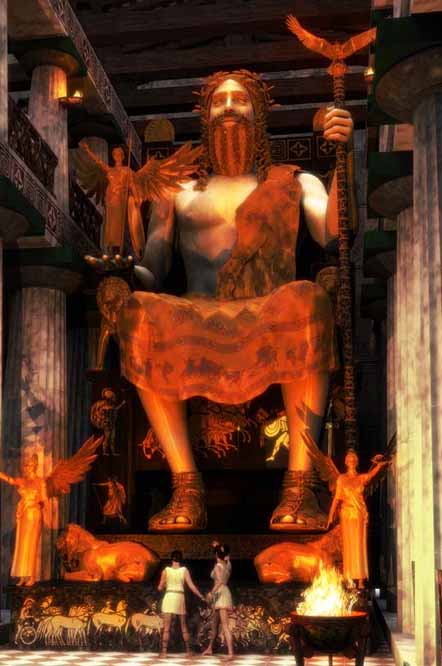
The Statue of Zeus at Olympia was one of the classical Seven Wonders of the Ancient World. It was made by the famed classical sculptor Phidias (5th century BC) circa 432 BC in Olympia, Greece.[1]The seated statue, some 40 feet (12 meters) tall, occupied the whole width of the aisle of the temple built to house it. "It seems that if Zeus were to stand up," the geographer Strabo noted early in the 1st century BC, "he would unroof the temple."[2] Zeus was a chryselephantine sculpture, made of ivory and accented with gold plating. In the sculpture, he was seated on a magnificent throne of cedarwood, inlaid with ivory, gold, ebony, and precious stones. In Zeus' right hand there was a small statue of Nike, the goddess of victory, and in his left hand, a shining sceptre on which an eagle perched.[3] Plutarch, in his Life of the Roman general Aemilius Paulus, records that the victor over Macedon “was moved to his soul, as if he had beheld the god in person,” while the Greek orator Dio Chrysostom wrote that a single glimpse of the statue would make a man forget his earthly troubles.The circumstances of its eventual destruction are a source of debate: some scholars argue that it perished with the temple in the 5th century AD, others argue that it was carried off to Constantinople, where it was destroyed in the great fire of the Lauseion (Schobel 1965). According to Lucian of Samosata in the later second century, "they have laid hands on your person at Olympia, my lord High-Thunderer, and you had not the energy to wake the dogs or call in the neighbours; surely they might have come to the rescue and caught the fellows before they had finished packing up the swag."[4]Perhaps the greatest discovery in terms of finding out about this wonder came in 1954-1958 with the excavation of the workshop at Olympia where Phidias created the statue. Tools, terracotta molds and a cup inscribed "I belong to Pheidias" were found here, where the traveller Pausanius said the Zeus was constructed.[5][6][7] This has enabled archaeologists to re-create the techniques used to make the great work.


Temple of Artemis


The Temple of Artemis (Greek: Ἀρτεμίσιον Artemision, Latin: Artemisium), also known less precisely as Temple of Diana, was a temple dedicated to Artemis completely, in its most famous phase, around 550 BC at Ephesus (in present-day Turkey) under the Achaemenid dynasty of the Persian Empire. Nothing remains of the temple—not the first on its site and with evidence dating as early as the Bronze Age—which was one of the Seven Wonders of the Ancient WorldThe temple was a 120-year project started by Croesus of Lydia. It was described by Antipater of Sidon, who compiled a list of the Seven Wonders:I have set eyes on the wall of lofty Babylon on which is a road for chariots, and the statue of Zeus by the Alpheus, and the hanging gardens, and the colossus of the Sun, and the huge labour of the high pyramids, and the vast tomb of Mausolus; but when I saw the house of Artemis that mounted to the clouds, those other marvels lost their brilliancy, and I said, "Lo, apart from Olympus, the Sun never looked on aught (anything) so grand". (Antipater, Greek Anthology [IX.58])

Mausoleum of Maussollos


The Tomb of Maussollos, Mausoleum of Maussollos or Mausoleum of Halicarnassus (in Greek, Μαυσωλεῖον Ἁλικαρνασσεύς, Μαυσωλεῖον τοῦ Ἁλικαρνασσοῦ (Ἀλικαρνασσοῦ)) was a tomb built between 353 and 350 BC at Halicarnassus (present Bodrum, Turkey) for Mausolus — a satrap in the Persian Empire — and Artemisia II of Caria, his wife and sister. The structure was designed by the Greek architects Satyrus and Pythius.[1][2] It stood approximately 45 meters (135 feet) in height, and each of the four sides was adorned with sculptural reliefs created by each one of four Greek sculptorsLeochares, Bryaxis, Scopas of Paros and Timotheus.[3] The finished structure was considered to be such an aesthetic triumph that Antipater of Sidon identified it as one of his Seven Wonders of the Ancient World. The word mausoleum has since come to be used generically for any grand tomb, though "Mausoleion" originally meant "[building] dedicated to Mausolus".


Colossus of Rhodes


The Colossus of Rhodes was a huge statue of the Greek god Helios, erected on the Greek island of Rhodes by Chares of Lindos between 292 and 280 BC. It was one of the Seven Wonders of the Ancient World. Before its destruction, the Colossus of Rhodes stood over 30 meters (100 ft) high, making it the tallest statue of the ancient world.[1]


Lighthouse of Alexandria


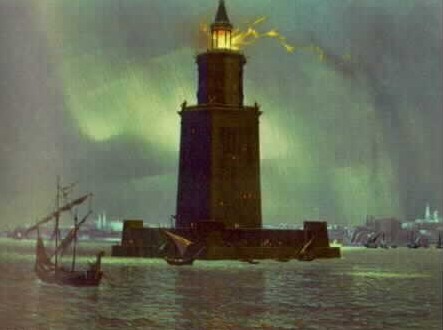
The lighthouse of Alexandria (or The Pharos of Alexandria, Greek: ὁ Φάρος τῆς Ἀλεξανδρείας) was a tower built in the 3rd century BC (between 285 and 247 BC) on the island of Pharos in Alexandria, Egypt to serve as that port's landmark, and later, its lighthouse.With a height variously estimated at between 115 ~ 150 meters (377 ~ 492 ft) it was among the tallest man-made structures on Earth for many centuries, and was identified as one of the Seven Wonders of the World by Antipater of Sidon. It was the third tallest building after the two Great Pyramids (of Khufu and Khafra) for its entire life. Some scholars estimate a much taller height exceeding 180 meters that would make the tower the tallest building up to the 14th century.